World's Best Medieval Armour Shopping Destination!

the most famous "Templar" helmet

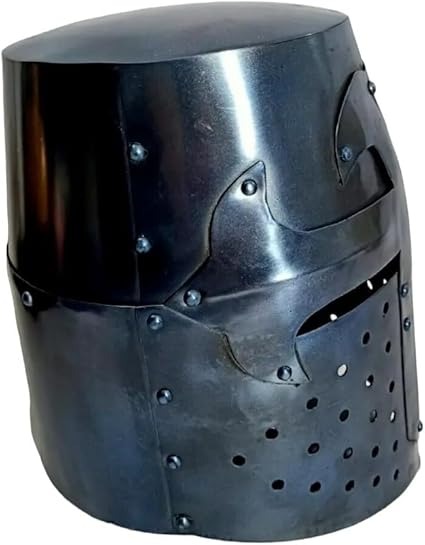
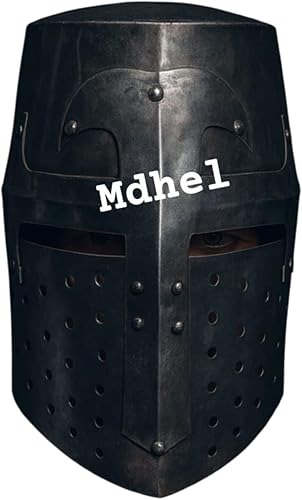
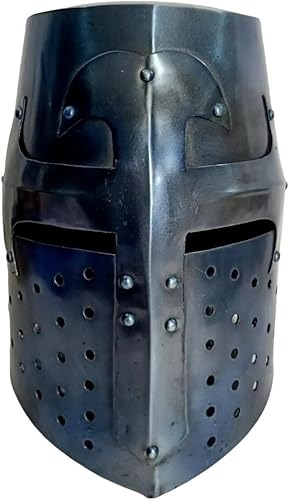
In the historical and ecclesiastical context of the Crusades, the "Templar Helmet" is a centerpiece of both military engineering and religious iconography. While the Order used various styles, the most definitive design is the Great Helm (Latin: Heaume), which defined the image of the "Soldier of Christ" from the late 12th to the early 14th century.


I. Architectural Form and Construction

The Great Helm was an architectural marvel of its time, mirroring the transition from the rounded Romanesque style to the pointed Gothic logic found in the cathedrals of Europe.

  • The Cylinder (The Skull): Unlike earlier "nasal" helmets that were forged from a single piece, the Great Helm was a composite structure. It was constructed from several heavy iron or steel plates riveted together. This created a rigid, "bucket-like" enclosure that rested on the shoulders, transferring the weight of the armor away from the neck.


  • The Faceplate: The front of the helmet featured a reinforced faceplate. This plate was vital for protecting against the high-velocity impact of a knight's lance during a charge.

  • The Crown: Early Templar helms featured a flat top, which provided a solid surface for defensive strikes. However, as warfare evolved, this gave way to the Sugarloaf design—a conical top that allowed blows from maces or axes to "glance off" rather than deliver a direct, crushing force.

In stock

₹ 140 ₹ 140

The Templar Great Helm

  • Shape: A sturdy, cylindrical steel "bucket" that completely enclosed the head and neck. Early versions had flat tops, while later versions (Sugarloaf) were pointed to deflect blows.


  • Protection: It offered the highest level of safety for the era, protecting the face and skull from heavy cavalry lances and sword strikes.


  • Vision & Breathing: Narrow horizontal slits (occularia) provided limited vision. Small circular or cross-shaped holes were punched into the lower faceplate for ventilation.


  • Symbolism: In the Templar Order, these were often kept plain and austere to reflect their vow of poverty, though some featured a brass or painted cross reinforcing the faceplate

loading..
Please wait...